Showing posts with label bees. Show all posts

Sunday, October 23, 2011

Making Mead

Saturday, October 22, 2011.  The beginning of a new tradition.

Trudi and John invited wonderful people to their home for a mead making day.  A year from now we'll gather again to taste our projects and start the next batch.

Bottles washed, honey measured.
Honey from local produces Haefli and Soffel and a variety of yeasts made the recipe.  We harvested no honey this year from our bees.  Maybe next year.  Earlier that day I winterized three strong hives though, sliding "bee cozies," two inch foam boxes, over them to insulate them from the -30 degree chill.  I also arranged straw bales in a wind break.
Contemplating the love letters...
Probably the most important 'ingredient' was the intention we set for each bottle.  Elaine, fermenter extraordinaire, writes "love letters" for each batch of kefir, kim chee, and kombucha, having read Masuro Emoto's work related to the formation of water crystals under the influence of water, pictures and music. According to Emoto, sending positive messages to water influences its symmetry of crystals and beauty.  Elaine explained that the two most beneficial sentiments to express were love and gratitude. 

Lavender from Chris Keitges' garden. Instead of using commercially prepared yeast, I added the lavender and its coating of naturally occurring local yeasts as the inoculant for my batch.  Thank you, Chris!
I have many sentiments of love and gratitude for this mead.  I'm grateful to John and Tom of Haefli Honey for welcoming the San Luis Valley WannaBeekeepers to tour their honey house facility last summer and for the bottle of honey we each received as a memento of our trip.  I am grateful to Tracy Doyle for joining me on that trip and suggesting making a lavender mead.  I'm grateful to Chris Keitges for giving me some lavender from her garden to add to the mead.  I'm grateful to Patrick O'Neill and his family's grapes and raisins which are nourishing the yeast.  And I'm deeply grateful to the friends with whom I made the mead who host our bees on their wonderful organic farm.
Lavender mead
By then end of the evening, my bottle was covered with love letters.  They included "Thank you little friends... bees and yeasties!" and "Bee Kind to your Honey!"

Sunday, October 2, 2011

The Big Potato Dig

October 1st, 2011 Big Potato Dig at Ortega farm north of Alamosa, CO
Agronomist Patrick O'Neill invited me and several others to help hand dig potatoes from his research plot north of Alamosa, CO.   He is studying the impact of different soil conditions, amendments to the soil, etc on the nutrients in the potatoes. Because the potatoes in the different conditions needed to be kept separate from each other, it required hand digging and bagging them for weight.  He was also measuring the pounds of potatoes produced per 10 foot section of row.  Most of the potatoes were grown under organic conditions, but he also used the farmer's conventionally grown potatoes as the control condition for the study.  We were delighted to find worms in the soil; apparently, that is a pretty big deal here in the sandy soils of the San Luis Valley.  Somebody did something right with compost.

Volunteers dig the potatoes by hand to record how many pounds of potatoes are produced per ten foot row in each of the experimental conditions for the study.
Yukon Golds have pink eyes. Note the bits of straw in the soil--this helps with the worm hospitability.
It was a fun morning of chatting with other organically minded, local food-ies.  I worked a row with an organic farmer with blue hair, and we talked about beekeeping and GM canola.  Genetically modified canola, which is the only kind of canola allowed to be grown in the valley due to some legal weirdness, kills bees according to Tom Haefli, local commercial beekeeper.  He won't put his bees on canola fields, but California beekeepers will.

By lunch, we had bagged several samples.

You can't get much more local than this delicious lunch comprised of a roasted pumpkin from the nearby field, as well as potatoes (surprised?), spinach and Kretsinger beef.  Old timers told stories of sling-shotting rabbits while picking potatoes for  meat-and-potatoes field lunch.
It felt good to connect with people who not only believe in organic, sustainable food production, but who are doing something about it.  I was also happy to read today about a thirty-year study in Canada that shows that "organic farming outperformed conventional farming in every measure." 

Old-school earthen potato storage shed
After the potatoes are harvested by hand for the study, the farmer will harvest the rest of them by machine for donation to La Puente Homeless Shelter in Alamosa/the food bank network of the San Luis Valley.  Instead of giving them thousands of pounds all at once, the farmer will store them in an old-school earthen potato storage shed and deliver potatoes throughout the winter months.

Sunday, September 25, 2011

The Privilege of Stability

Privilege derives its roots from Latin, roughly a "private law" that applies to some but not all people.
Stability ... I like the fourth and fifth definitions quoted here from dictionary.com:
4.Chemistry . resistance or the degree of resistance to chemical change or disintegration.
5.resistance to change, especially sudden change or deterioration: The stability of the economy encourages investment.
Today I write about  resistance to disintegration and resilience. 


I attempt within these essays to weave together idea strands from the multiple facets of my life.  Privilege of Stability has been on my mind lately relative to my work with students with low test scores and the faculty who teach them.


Students with Low Test Scores/Developmental Education


My academic area is Developmental Education, which has also been known as remedial, pre-collegiate, college-prep, and probably other less flattering names (ie "dummy English").  The name of the discipline itself suffers from destabilization as people want new words to describe it once others realize what we're talking about and the word acquires stigma.  I am talking about students who arrive at college with low test scores in reading, writing, and/or math.  There can be many causes for these low test scores: high schools that didn't adequately prepare the students perhaps, but also being away from the subject(s) for any amount of time due to serving in the military or caring for family members or being in a career. We also have students who are English Language Learners, whose facility with English is the main barrier to understanding the directions on the tests and/or the content, many of whom are graduates of US high schools and therefore are not required to take the TOEFL for admission to college (Test of English as a Foreign Language).  We also have students with diagnosed and undiagnosed disabilities including learning disabilities like dyslexia and acalculia as well as physical, mental and cognitive disabilities.
In additional to the destabilizing forces of low preparation, changing careers/activities, struggles with the language of instruction/assessment, and/or diagnosed or undiagnosed disabilities, there may be additional destabilizing forces such as low socio-economic status, health challenges, transportation challenges, childcare challenges, off-campus jobs, family obligations, substance addiction challenges, motivational deficits, and even institutionalized discrimination related to ethnicity-race/class/gender/identity.  Perhaps you can start to see that developmental education is messy: high-need students who tend to have low course success rates, low GPAs, low graduation rates.  They also tend to have dramatic attendance challenges, to "drop off the face of the earth," and sometimes return several semesters later with amazing stories of incarceration, car accidents, family obligations, taking care of things they had to do, which were more important than completing the semester.  They want to succeed, and earnestly hope that they'll get the alfalfa harvest in by next weekend so they can come back and take those exams they missed, for example.

I feel fortunate that I graduated from high school in the same district that I started kindergarten.  I benefited from a coherent math curriculum, for example, that was planned to teach students math facts in third grade that laid a foundation for math concepts to be taught in fourth grade.  For students who experience moving from district to district, or who are out of school for long periods of time due to health problems or whatnot, they may have gaps in key concepts. Many find a good way of coping, but they are set up to struggle with math or other subjects for the rest of their education.

To compound their challenges, developmental students are often taught by the least prepared and least-supported faculty: adjunct, contingent, part-time, untenurable faculty.  90% of developmental courses in Colorado are taught by contingent faculty.  Both students and faculty are marginalized, and administrators are reluctant to dedicate resources and time to solving the big complicated challenges that have less return on investment than the college's other responsibilities.  Messy.

I must also mention the social justice impact of supporting developmental education.  Students in my classes tend to represent ethnic minority groups (70.2% in dev ed courses; the campus-wide rate is closer to 40%), tend to be first generation students whose parents haven't graduated from college (63.4%), and tend to be Pell grant eligible, indicating from low SES family/support (74%) more than non-developmental students.  There were 287 graduates in May of 2011, and 88 (30%) of them took one or more developmental courses at ASC.  If we didn't have developmental coursework as a "gentle pathway" into or back into higher education, we would have dramatically fewer college graduates.

Faculty Professional Development and Stability

The Colorado Association for Developmental Education (CoADE) is in a position to offer scholarships to faculty to attend conferences and/or the Kellogg Institute.  I was developing an application process for these scholarships last week, and recognized my bias toward "stable" faculty: one criteria for scholarship eligibility points is "Are you presenting at the conference you'll be attending?"  I'm grateful that I've worked for the same college for several years in the same discipline.  I've learned the seasons of the call for proposals for the major conferences in dev ed, and have been able to plan ahead to submit proposals several months in advance of the conference.  New faculty, faculty who are "Road Scholars" teaching at multiple schools in a region, faculty trained in other disciplines who are making ends meet by teaching dev ed courses... they sometimes receive little to no faculty orientation or resources, and not surprisingly teach for one semester and are out the next.  There are some colleges that have 100% turnover of developmental faculty from semester to semester.  There are even colleges with MORE than 100% turnover since low paid, low supported faculty sometimes have no problem leaving in the middle of a semester for a better job.  These are extreme examples, and I'm very grateful that we've had a fairly stable group of faculty at Adams State.  However, my point is that it is a blessing, a privilege, to be able to be in one place long enough to get business cards printed, a phone number that doesn't change from year to year, a mailing and email address to receive those calls for proposals for conferences that tie us into our academic communities.  It's a blessing to be in a place long enough to work on bigger projects, to develop one's vision, identity and reputation.

Stability and choices

I used to be in a destabilizing relationship.  Eventually I made the decision to leave that situation, and I've been mindful of choosing relationships that promote stability, recognizing that a lot of relationships create at worst abuse and chaos and at best "opportunities for compromise." One need not look further than the the domestic abuse shelter to see people experiencing extreme destabilization related to families and/or partnerships. Relationships can be destabilizing, but so can ending them.  Divorce is a destabilizing force.  In addition to relationship destabilization, sleep patterns, time management, balance of activities, stress, substance use/abuse and diet/exercise choices can lead to more or less stability in one's life.  This semester I've been talking with my students about "using the present to plan the future" and want to draw their attention to the types of behaviors that can lead to stable jobs, stable relationships, stable health and quality of life.
Stability and choices I don't control

There are also destabilizing forces I cannot control.  Health, for example. A friend posted on facebook about his challenges with not being able to afford health insurance.  A barrage of cruel posts from "friends" indicated they thought he was a failure for not buying health insurance, that he was a parasite on society, that he deserved any calamities he might experience. While I like to think of myself as the "master of my fate," I have to recognize destabilizing forces outside of my control.  Health insurance tied to one's employment is a dumb system.  More than half of medical bankruptcies involve people who WERE insured before they were injured or became sick, who later lost work-related insurance and racked up their astronomical bills.  Even when we make healthy lifestyle and diet choices, environmental toxins or just plain "bad luck" could lead to cancers or accidents caused by other people. 

Stability and sacrifice


If you've enjoyed the privilege of stability throughout your childhood, it probably involved the sacrifice of others.  The traditional nuclear family--mom, dad, and kids--generally required sacrifices from both parents in order to provide stability for the kids.  Generally, moms did more sacrificing behaviors to preserve the stability of marriage as well as to provide the most stable home life and schooling for the kiddos. Their career choices and types of responsibilities women are willing to take on at work are still often second priority after her family and as a consequence have real economic impact on the salaries that married women earn.  Women today face a big challenge regarding stability and sacrifice: having children, even wearing an engagement ring to a job interview, has consequences for her employability.  When a woman marries and/or has children, she's generally setting herself up to sacrifice her own ambitions for the benefit of creating stability for others.  Somebody's got to be willing to miss opportunities at work to instead take care of a sick child, or relocate to a different city for a spouse's promotion.  I'm using women in these examples, but certainly many men are also finding themselves taking care of children as stay-at-home dads or single parents or the spouse of a professional.

Yoga and Bees

Yoga promotes at least two kinds of stability: stability of muscles/balance, and discipline of mind. 

Bees... I'm so grateful to have a relationship with the owners of the organic farm which allows my bees to have a non-destabilizing diet of unpesticided nectar.  Having healthy bees in our environment promotes overall food stability.

In closing, I'm bringing before your eyes examples of privilege. I feel privileged to have a stable job, stable relationships and to some degree stable health care.  I see students and colleagues who are experiencing less stability than I have, and I'm humbled by how I could easily be in similarly destabilizing situations (a car accident, a layoff) and feel I should use my privilege to expand the privilege of stability to all.

Sunday, June 19, 2011

Triangles

Triangles, Triangulation, Triads... three things, three ideas, three people in relation to each other.  Dyads turning into Triads.  Dynamic tension and creativity, possibilities within boundaries, and new frontiers...

Three things...I now have three hives of bees.  As soon as I finish this blog post, I'll head out to the farm to see how they are doing.  Two hives are of one style; the third is different.  I will compare the three throughout the season.  I'm eager to see how they interact with each other. There is strength in numbers, and I'm hopeful that if there are any problems I can combine and recombine the three into new possibilities (possibili-bees?).

Three ideas.... Talking with a friend yesterday, he kept posing either/or questions, seemingly like he predecided the answers for me.  I kept having to rephrase the question into one I could answer.  This is my example of the dynamic tension between twos and threes--he was pulling the conversation in one direction--either or--and I wanted to insert my own perspective--the third.  I'm sure there is a musical connection here, too--the one and the five of a triad, with the third (major or minor?) determining more meaning.

Three people, third wheel, the other "other", three examples of three triads... Two friends plus a new friend equals jealousy, comparison.  Potential for more fun, but also for toxic triangulation, positioning, gossiping. A stable pair, with a third wheel, disrupts balance, brings attention to the stability. The other "other", the grass is greener; I see more with him because I saw with him.

Sunday, May 29, 2011

Bee update May 27, 2011

Friday evening I checked on the bees at KW Farms.  I was worried because I had called Trudi a few times to ask about the bees and she hadn't returned my calls.  I know farmers in May are very busy, so that was understandable that she wouldn't have a moment to make a phone call.  She did get a chance to call me Friday morning, but said she hadn't seen any bees on her new flowers that she planted.  I prepared myself for the worst, which is to say, I prepared myself to find an empty hive box.

A few minutes after Trudi's call, I received another call, this one from my doctor with results from some lab tests earlier in the week.  She wanted me to come in for more tests and transferred me to the scheduler.

How are these two phone calls related?  I will attempt to explain how my attitude towards these bees and towards my health are related.

But I'll contextualize it with yet another digression. 

Card making.  Two years ago, I started making greeting cards with my friend Ellen and some other ladies.  This hobby drives me crazy and yet teaches me patience.  I sit with these women, gluing bits of paper together, lining up stamps to be centered and straight.  And then I silently curse at myself when the bits of paper get crinkled, or the stamp is off-center and crooked.  I glare at my creation, thinking how a kindergartner might have done a better job.  Then we pass around examples of our work, and the ladies comment on the beautiful color combinations I chose, or the neat way I did X, which they had never seen before.

My point is that I have a tendency to focus on the negative first, to critically analyze, before appreciating the whole, or seeing the good parts of the big picture.

I did this behavior when I first opened the hive.  Here is what I saw:
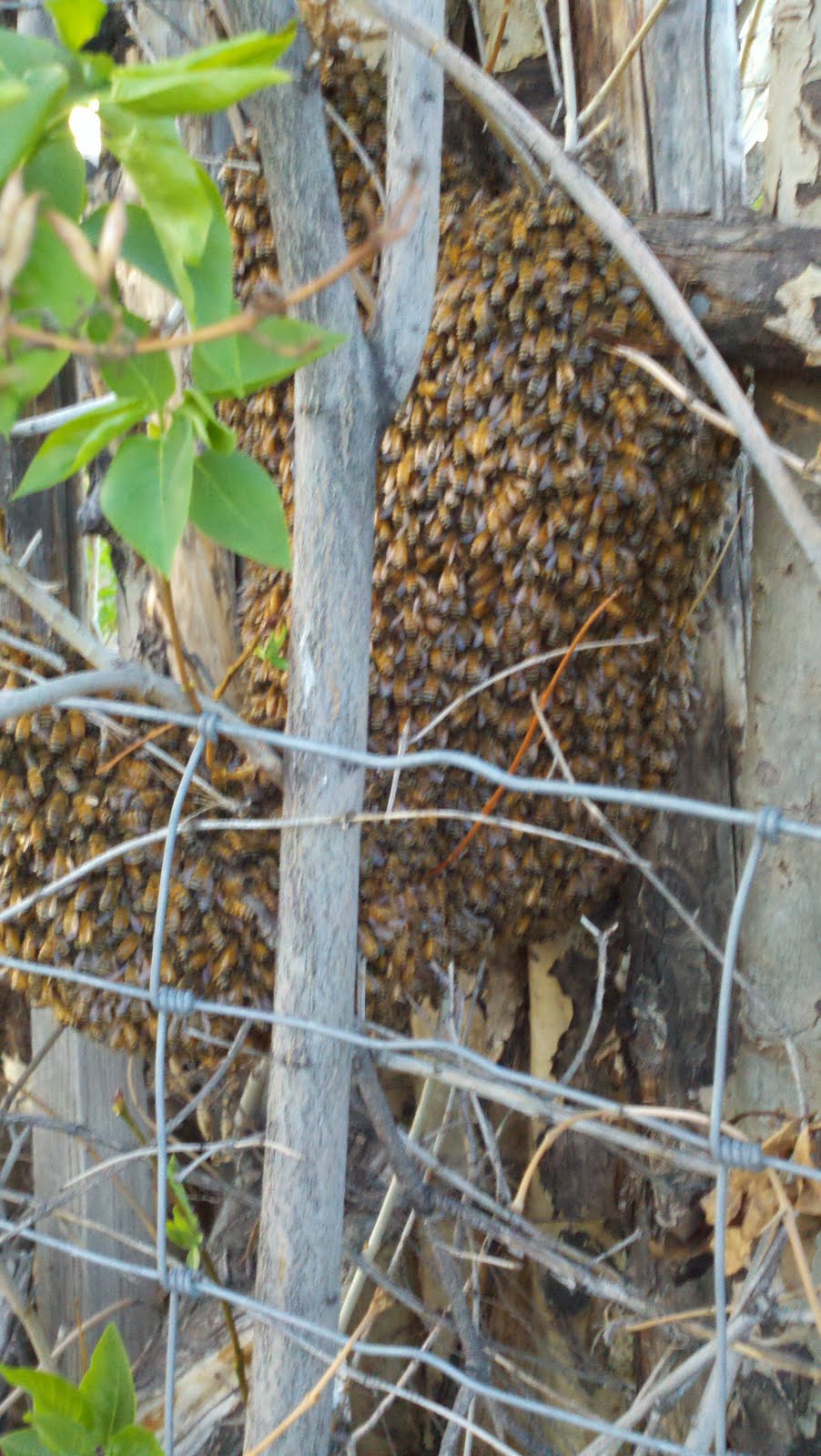
So, yes, there are bees, but very few bees.  Damn, I thought.  They're dying.  They're weak.  Bothe Kretsinger, Trudi and John's son, was with me so I talked in a stream-of-consciousness way as we examined the hive.  (I may very well have talked to myself had I been alone, I'm not afraid to admit). As I talked through my anxiety, my fears, I started to realize a few things, started to observe the positive things going on in this hive.  For one, the bees were putting away some honey.  This is an excellent sign.  There are flowers from which they are foraging.  A second positive observation was that they were mellow, "queenright" as beekeepers say, meaning that they weren't freaking out/spazzy because the wasn't a laying queen sending out the right pheromones. 

Once I started to see the positives, I started thinking from a positive frame of reference.  I did some math.  Since I installed the bees on May 7th, no eggs could have been laid prior to that date.  It had only been 20 days, and worker bee gestation is about 21 days.  So, the very first bee eggs laid would just be hatching later this week, while the worker bees who navigated the swarm process would have had to have been older, fully mature-winged bees, meaning they were nearing the end of their life cycle, and starting to die.  It would make sense that there would be a window of time, this week specifically, when good things were happening in the hive (wax production, honey production, thousands of eggs being laid and tended to) with a general decrease in the overall number of bees and bee activity.

Bothe with the bees
As I drove off from the farm, I wept.  I was so happy to see these bees, so afraid that they were dead or dying, so focused on the negative that I forgot to look to the positive, to the things going well.  I worry too much.  I put too much emphasis on the success or failure of every hive, that it means *I* am a success or failure. And since I have this tendency to see the negative first, I forget about the successes of these three weeks of life, and instead focused on imminent death, the things I should have, might have, could have, done to make things better for the bees.

So, back to the test results. It's good that I see my doctor every year, that I take good care of myself.  It's good to have follow up tests, and do whatever will be necessary. These are the positives, from which I can base a positive frame of reference for whatever will come next. 

Saturday, May 7, 2011

First swarm call of the season!

Fairly established swarm at Claire and Smokey Barker's house in Mosca, CO. May 8th, 2010--almost a year to the day!  It is swarming season in the San Luis Valley.

Yesterday, as I was walking down Third Avenue, a car beeped at me and pulled over.  "You're a beekeeper, right?" Yes.  Yes, I am.  "We have a swarm.  What should we do?"

Now, some context.  Alamosa has an ordinance specifically forbidding bees in the city limits.  We also spray Malathion in the city limits for Mosquito control.  According to the EPA website, "Malathion is highly toxic to insects, including beneficial insects such as honeybees."

The driver explained that the bees were along a fence in a tree.  That they had been there all afternoon.  Didn't seem to be bothering anyone.

There were a few possible outcomes.  1) The bees would swarm again and find another temporary location.  I've gone on swarm calls where the bees had disappeared by the time I assembled my equipment and got to the scene.  2) They would still be there the following morning. In the cool pre-sunrise, they would be docile and clumped together to keep warm.  We agreed to touch base in the morning.

And a third option, that I don't want to think of as an option: He could have called an exterminator.  More on that later.

I woke before sunrise but waited until 6 am to call.  Yes, indeed, they were still there.  "I'll be right over."

I brought a cardboard box, my smoker, and my bee suit and veil (not this bee suit).  My plan was that I would set the box under the branch, give it a good shake, and all the bees would tumble into the box, which I would then fold closed, stick in the beemobile, and transport to KW Organic Farms north of Alamosa.

When I arrived I discovered it would not be a simple shake of a branch.  These bees were all wrapped around branches, wire fencing, and the neighbor's fence.  The neighbor's sprinkler system was also watering at the time.  In other words, not optimal conditions. I was not going to be able to simply set my box under the branch and shake.
Before...the swarm in a lilac bush at First and Ross.


I set to work.  I started with a brush, trying to sweep them into the box.  This had limited success.  A dozen bees or so would cling to the fibers of the brush, so then I would gently untangle them and drop them into the box.  I worked up my courage and decided to just reach my hand into the mass and pull out a handful of bees.  

It was still early morning cool, which in Alamosa in May means that I could see my breath, but did not wear a coat. The bees were amazingly calm. My hands scooped the bees, and the bees grasped to me and allowed me to drop them into my box.  Handful after handful.  They got a bit more agitated, perhaps because I was starting to bug out, so I decided to talk to them. 

I introduced myself. Some beekeepers believe that bees choose their keepers, so I wanted to tell them how excellent Trudi Kretsinger and John are, how much they care about their animals and their land, how they're interested in supernutrition and taking care of the soil. How they wanted to plant things that would be best for bees. "You'd really like them." 
I acknowledged that they didn't know me, but that I really believed moving to the Kretsinger farm would be better than staying in this tree and getting sprayed with Malathion. That is was probably upsetting to be grabbed and stuck in a box, but that this wonderful farm is in the shadow of Mount Blanca, that the only other place I could think that might be more desirable for a bee would be a lavender field in Provence in August, but that this was definitely a close second.
 I called Trudi.  "Sorry to call so early, but I have a box a bees!" She asked if I'd like to join them for breakfast.  I love her.  Yes, of course, breakfast.  I arrived and met Patrick, an agronomist, and John [seed consultant?] who were breakfasting with Trudy and John and talking about what to plant.


I walked in Trudi's house dressed like this, and she said I looked "sexy."

After homemade cinnamon rolls and strong coffee, Trudi and I headed to the fields to find a nice place for the girls, along the way seeing coyotes and baby owls (not at the same time).  We decided on a place under some Russian Olive trees, near water and easily accessible by the beemobile.
After...at the Krestinger Organic Farm
I'll check back in a few days to see how they're doing.  It is quite possible they will swarm again in the next day or so.  Trudi, John and I discussed next steps...we should order some more hive equipment in the event there are more bees to be rescued and relocated.  I want to explore the possibility of Top Bar Hives. I should write an article for the Valley Courier about Bee Swarm rescue versus extermination.  

I also called the local pest control to let them know I'd be happy to give a first shot at rescuing honey bees when they get calls.  I should also call the local police departments, sheriffs office, parks and recreation, and Co-op to let them know I'm available for bee rescue/extraction.