|
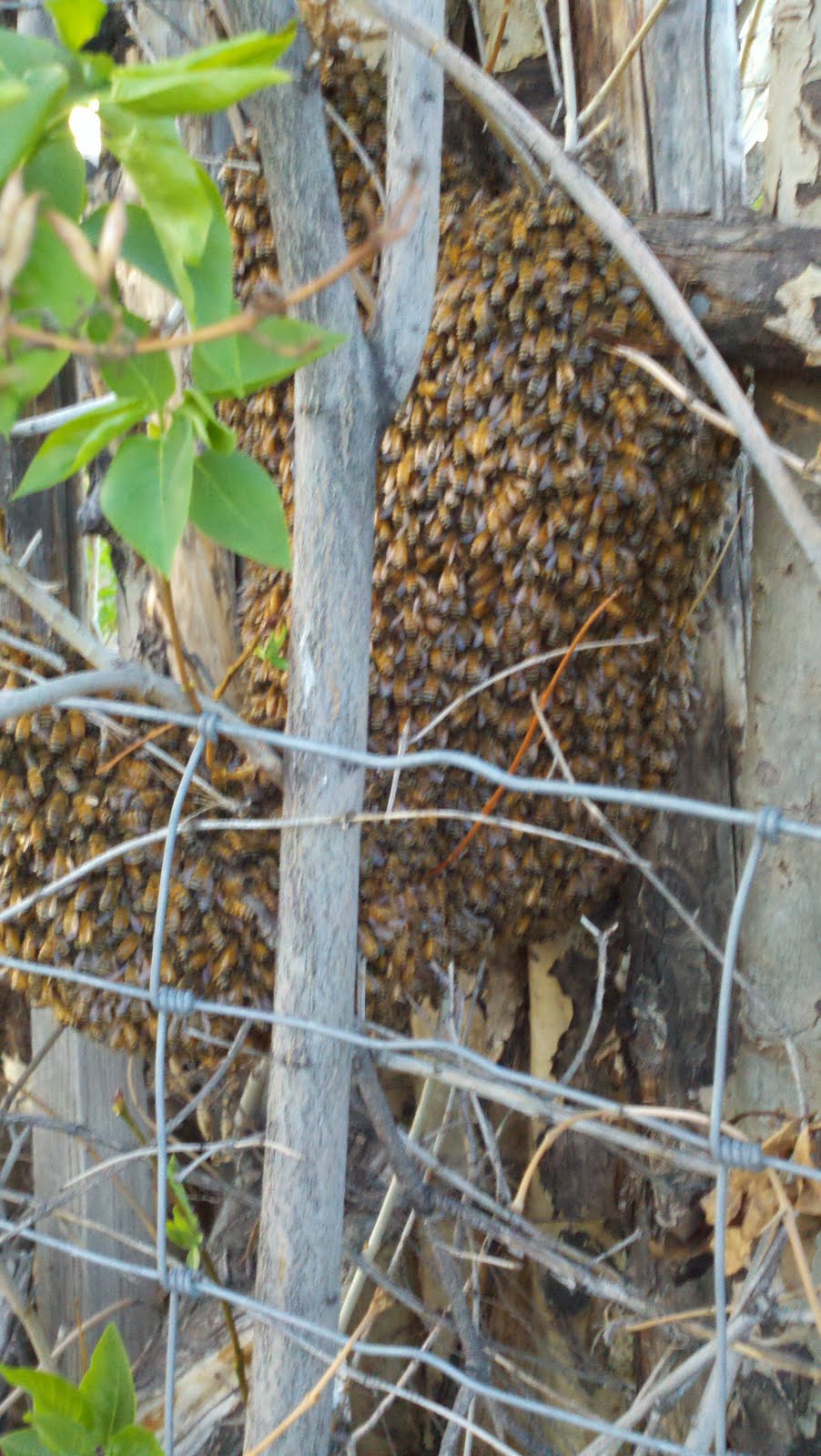
| Fairly established swarm at Claire and Smokey Barker's house in Mosca, CO. May 8th, 2010--almost a year to the day! It is swarming season in the San Luis Valley. |
Yesterday, as I was walking down Third Avenue, a car beeped at me and pulled over. "You're a beekeeper, right?" Yes. Yes, I am. "We have a swarm. What should we do?"
Now, some context. Alamosa has an ordinance specifically forbidding bees in the city limits. We also spray Malathion in the city limits for Mosquito control. According to the
EPA website, "Malathion is highly toxic to insects, including beneficial insects such as honeybees."
The driver explained that the bees were along a fence in a tree. That they had been there all afternoon. Didn't seem to be bothering anyone.
There were a few possible outcomes. 1) The bees would swarm again and find another temporary location. I've gone on swarm calls where the bees had disappeared by the time I assembled my equipment and got to the scene. 2) They would still be there the following morning. In the cool pre-sunrise, they would be docile and clumped together to keep warm. We agreed to touch base in the morning.
And a third option, that I don't want to think of as an option: He could have called an exterminator. More on that later.
I woke before sunrise but waited until 6 am to call. Yes, indeed, they were still there. "I'll be right over."
I brought a cardboard box, my smoker, and my bee suit and veil (not this
bee suit). My plan was that I would set the box under the branch, give it a good shake, and all the bees would tumble into the box, which I would then fold closed, stick in the beemobile, and transport to KW Organic Farms north of Alamosa.
When I arrived I discovered it would not be a simple shake of a branch. These bees were all wrapped around branches, wire fencing, and the neighbor's fence. The neighbor's sprinkler system was also watering at the time. In other words, not optimal conditions. I was not going to be able to simply set my box under the branch and shake.
 |
Before...the swarm in a lilac bush at First and Ross.
I set to work. I started with a brush, trying to sweep them into the box. This had limited success. A dozen bees or so would cling to the fibers of the brush, so then I would gently untangle them and drop them into the box. I worked up my courage and decided to just reach my hand into the mass and pull out a handful of bees.
It was still early morning cool, which in Alamosa in May means that I could see my breath, but did not wear a coat. The bees were amazingly calm. My hands scooped the bees, and the bees grasped to me and allowed me to drop them into my box. Handful after handful. They got a bit more agitated, perhaps because I was starting to bug out, so I decided to talk to them.
I introduced myself. Some beekeepers believe that bees choose their keepers, so I wanted to tell them how excellent Trudi Kretsinger and John are, how much they care about their animals and their land, how they're interested in supernutrition and taking care of the soil. How they wanted to plant things that would be best for bees. "You'd really like them." I acknowledged that they didn't know me, but that I really believed moving to the Kretsinger farm would be better than staying in this tree and getting sprayed with Malathion. That is was probably upsetting to be grabbed and stuck in a box, but that this wonderful farm is in the shadow of Mount Blanca, that the only other place I could think that might be more desirable for a bee would be a lavender field in Provence in August, but that this was definitely a close second. I called Trudi. "Sorry to call so early, but I have a box a bees!" She asked if I'd like to join them for breakfast. I love her. Yes, of course, breakfast. I arrived and met Patrick, an agronomist, and John [seed consultant?] who were breakfasting with Trudy and John and talking about what to plant.
 |
I walked in Trudi's house dressed like this, and she said I looked "sexy."
After homemade cinnamon rolls and strong coffee, Trudi and I headed to the fields to find a nice place for the girls, along the way seeing coyotes and baby owls (not at the same time). We decided on a place under some Russian Olive trees, near water and easily accessible by the beemobile.
 |
| After...at the Krestinger Organic Farm |
I'll check back in a few days to see how they're doing. It is quite possible they will swarm again in the next day or so. Trudi, John and I discussed next steps...we should order some more hive equipment in the event there are more bees to be rescued and relocated. I want to explore the possibility of Top Bar Hives. I should write an article for the Valley Courier about Bee Swarm rescue versus extermination.
I also called the local pest control to let them know I'd be happy to give a first shot at rescuing honey bees when they get calls. I should also call the local police departments, sheriffs office, parks and recreation, and Co-op to let them know I'm available for bee rescue/extraction. |
|
|
|